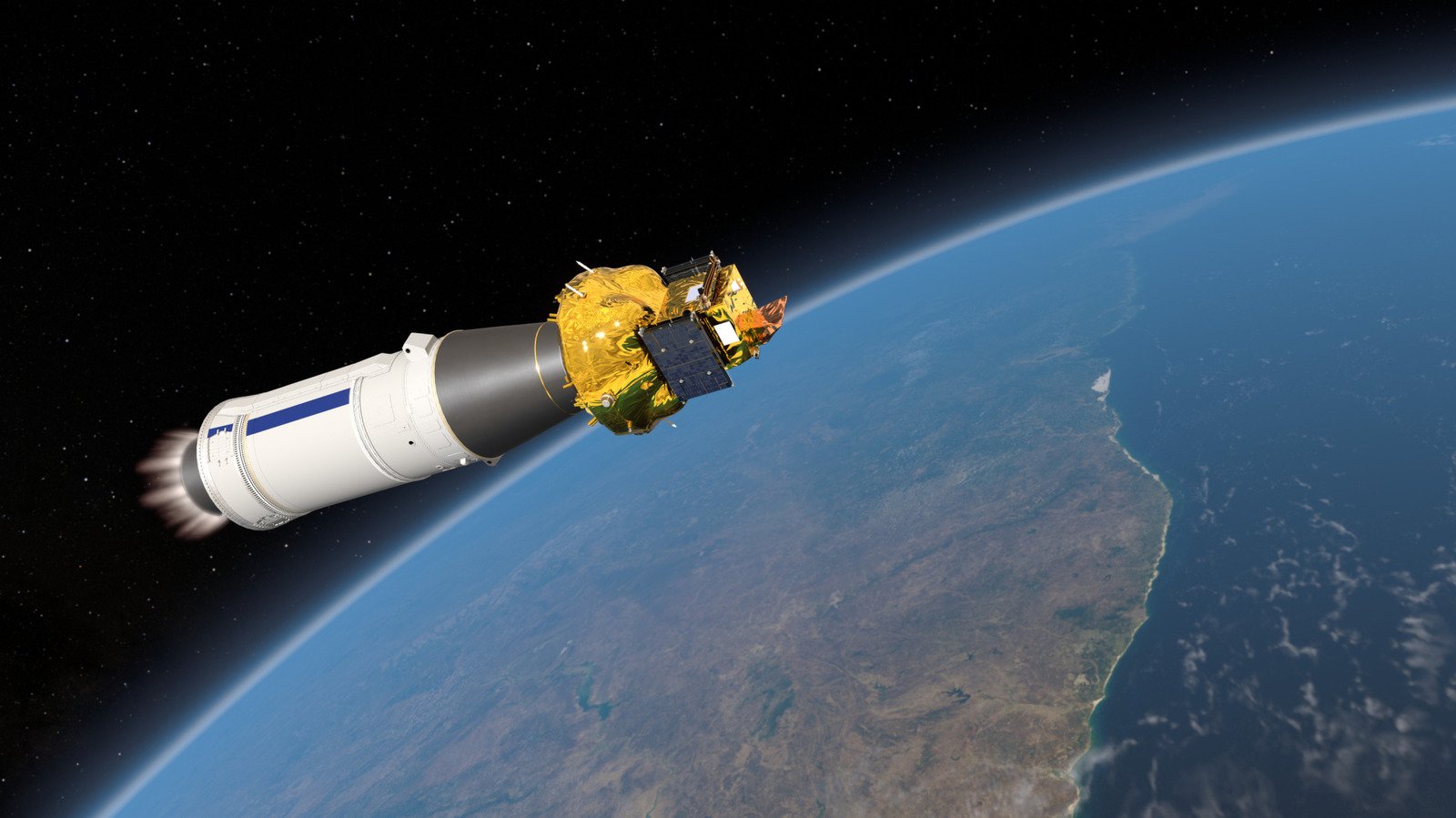
In a groundbreaking collaborative effort, China and Europe are set to launch a spacecraft designed to observe the Earth’s magnetosphere in real time, an endeavor aimed at shedding light on how solar storms impact our planet’s magnetic field. The mission, named SMILE—an acronym for Solar wind Magnetosphere Ionosphere Link Explorer—will mark the first comprehensive space science partnership at the mission level between the Chinese Academy of Sciences and the European Space Agency (ESA).
The collaboration began in 2015 when ESA and CAS issued a joint call for mission proposals. Out of 13 submissions, SMILE was selected, entering its study phase in early 2016. Once launched, the spacecraft will follow an unusual elliptical orbit, fluctuating between just 5,000 kilometers above the South Pole and soaring to 121,000 kilometers above the North Pole. This extended trajectory aims to provide a vantage point that enhances observations of the interactions between solar wind and the Earth’s magnetosphere, an area of study that holds significant implications for understanding geomagnetic storms, which can pose hazards to both technology and infrastructure.
Though scientists currently possess a solid understanding of these interactions, the overall picture remains incomplete. Existing missions, such as NASA’s Magnetospheric Multiscale (MMS) and the ESA-NASA Solar and Heliospheric Observatory (SOHO), are primarily focused on localized events rather than providing a comprehensive global perspective. SMILE is poised to fill this critical research gap, equipped with a soft X-ray imager capable of mapping the boundaries of the magnetosphere worldwide.
The primary objective is to monitor the Earth’s magnetic shielding as solar eruptions occur. Improved observations from SMILE could lead to advancements in predicting geomagnetic storms before they affect global systems, with recent historical events underscoring the urgency of such efforts. A notable incident in May 2024 disrupted satellite navigation and radio communication, while the catastrophic storm of 1989 resulted in a nine-hour blackout of Quebec’s power grid, affecting millions.
Nevertheless, the launch of SMILE has encountered some setbacks. Originally scheduled for April 9 from the European Spaceport in French Guiana, ESA announced a delay due to technical issues related to the production line of subsystem components. As of now, no new launch date has been confirmed.